The questions to ask a home inspector come down to trust: who trained them, whose standards they work to, who pays them, and what you'll get in writing. In Ontario they matter more than you might think, because the province doesn't license home inspectors today. Below are the questions worth putting to any inspector, with Jim Ward's answers wherever he has published them.
First, where Ontario's law stands
Ontario passed the Home Inspection Act, 2017 (S.O. 2017, c. 5, Sched. 1). Once in force, it would bar anyone from performing a home inspection unless they're licensed as a home inspector, and it would set rules for inspection contracts and reports. It isn't in force. The e-Laws version, current to November 5, 2026, carries the note that the Act is not yet in force and will come into force on a day to be named by proclamation of the Lieutenant Governor.
Until that day, there's no provincial home inspector licence to check. A "certified home inspector" in Ontario holds a certification from a private association, so the useful questions are which association, what it required, and whether you can verify it.
The questions
1. What training do you have?
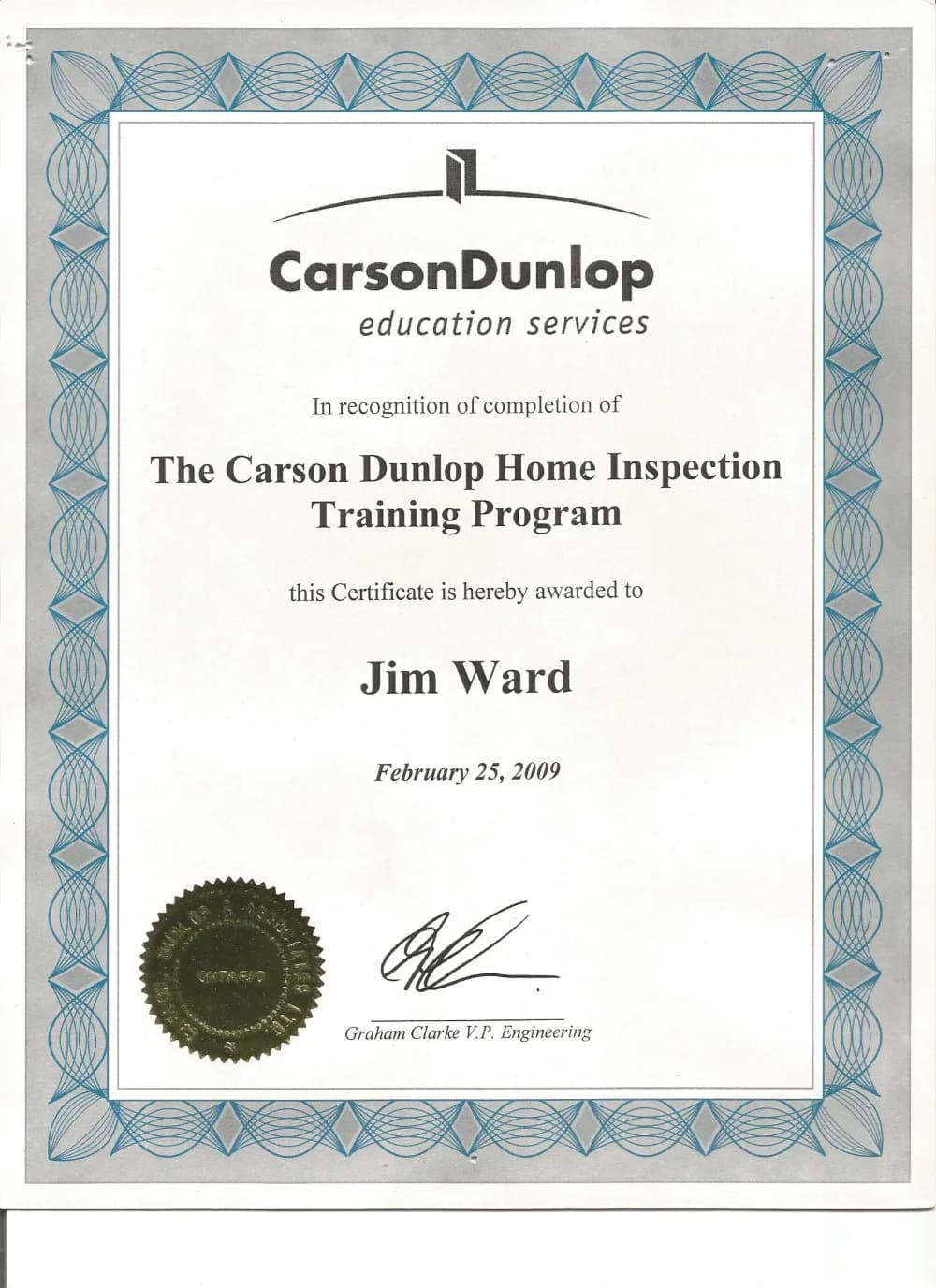
Look for formal training plus time spent working under someone experienced. Jim completed the Carson Dunlop Home Inspection Training Program (his certificate is dated February 25, 2009). In 2008 he worked with a Registered Home Inspector for a year, then opened his own business in 2009. Before that, he started in construction at a young age, both residential and commercial.
2. Who certifies you, and can I check it?
Ask for the association's name and a way to verify membership yourself. Jim is a Certified Professional Inspector (CPI) with the International Association of Certified Home Inspectors (InterNACHI), and he holds InterNACHI's Certified Master designation. His InterNACHI ID is NACHI11112202, and his InterNACHI profile says the ID can be used to verify his certification at any time.
Ask about ongoing learning, too. InterNACHI's Code of Ethics requires CPIs to meet its continuing education requirements and to pass its online inspector exam once every three years.
3. Which standards of practice do you follow?
A written standard tells you what the inspector has agreed to look at and what's excluded. Jim follows the InterNACHI Home Inspection Standards of Practice and its Code of Ethics. Our guide to what a home inspection covers walks through that standard system by system.
4. Can I see a sample report?
This is the single most revealing request. You'll see how findings are explained, whether photos are included, and whether the recommendations are specific. Jim's sample report is on his site. His reports are full colour, emailed, with all the images of your inspection, and they set out material defects with recommendations to monitor, repair or replace.
5. When will I get the report?
Conditional periods are short, so timing matters. With Jim, you get the report the same day.
6. What isn't included?
Every standard has exclusions. Under InterNACHI's, they include septic systems, wells, building code compliance, and environmental concerns such as mould, radon and asbestos. Ask how the inspector handles each one that applies to your property. Jim offers a water sample and a water flow test for homes on a well (call for pricing); for anything else on that list, ask him whether he covers it, or plan on a specialist.
7. Can I come along?
Many buyers learn more in an hour on site than from any report. Ask whether you can attend, and whether the inspector will walk you through the findings at the end. Jim's own line on the subject: "My job isn't finished until you understand everything in your report."
8. Do you pay or receive referral fees?
This is the conflict-of-interest question. Under the InterNACHI Code of Ethics Jim follows, he doesn't accept or offer commissions, rebates or referral payments to or from real estate agents or anyone else with a financial interest in the sale. His site describes his reports as having no vested interest. You're free to choose your own inspector whether or not your agent suggests one.
9. Will you offer to fix what you find?
An inspector who also sells repairs has a reason to find work. The InterNACHI Code of Ethics bars members from performing or offering repairs, for an added fee, on a structure they've inspected for 12 months afterwards, and Jim follows it.
10. Is there a written contract?
There should be, and you should read it before inspection day. Jim uses a written contract that sets out the services, the limitations and the fees.
11. Who else will see my report?
Your report is about your purchase, so it shouldn't go to anyone without your say-so. Jim doesn't release anything about the inspection or the client to a third party without the client's written consent, except for safety or legal reasons.
12. What insurance coverage do you carry?
This is a fair question for any inspector, Jim included. Ask whether they carry errors-and-omissions and general liability coverage, what the limits are, and whether they'll send proof. Then read what the contract says about liability.
13. How long will it take, and what does it cost?
Jim's view is that doing a house properly takes at least three hours. His prices are $450 for a condo and $500 for a home up to 1,800 sq ft, both including HST; larger homes and other services are call for pricing. The cost guide compares those numbers with published Ontario figures.
Warning signs
- No sample report, or a reluctance to show one.
- A scope that isn't written down until you're at the door.
- An offer to do the repairs, or to refer you to a relative who will.
- A price far below everyone else's, with no explanation of what's left out.
- Pressure to skip the inspection or shorten it to make a deadline.
Selling instead of buying? The same questions apply to a pre-listing inspection. Jim serves Haldimand, St. Thomas and Elgin, Norfolk and the counties around them. Read more about Jim, or request a quote.
Questions people ask
Do home inspectors need a licence in Ontario?
Not today. Ontario's Home Inspection Act, 2017 would require one, but e-Laws (current to November 5, 2026) notes the Act is not yet in force. Until it's proclaimed, there's no provincial licence to check.
What does "certified home inspector" mean in Ontario?
It means certified by a private association, such as InterNACHI. Ask which association, what it required, and how to verify it. Jim is an InterNACHI Certified Professional Inspector, ID NACHI11112202.
How do I check an InterNACHI inspector's certification?
Look up the inspector's InterNACHI profile and ID. Jim's profile says his InterNACHI ID, NACHI11112202, can be used to verify his certification at any time.
Should my real estate agent choose my home inspector?
You can take a suggestion, but the choice is yours. Ask any inspector about referral payments. Under the InterNACHI Code of Ethics, Jim takes no commissions or referral fees from agents.
Can the home inspector do the repairs afterwards?
Under the InterNACHI Code of Ethics, members don't perform or offer repairs, for an added fee, on a home they've inspected for 12 months afterwards. Jim follows that rule.